Digital Twin & AAS
From Fragmented Layers to a Unified Data Foundation
Modern data centers consist of three distinct layers — Facility, Hardware, and Virtualization — each managed by different teams with different tools, terminologies, and information systems. The Digital Twin and the Asset Administration Shell (AAS) address this fragmentation at the data level: they provide a unified, semantically consistent, and machine-interpretable representation of all assets across all three layers.
This is not a new dashboard or an additional monitoring tool. It is a shared information foundation that connects what was previously separate and makes it accessible to humans and systems alike.
The Digital Twin — A Living Representation Across All Layers
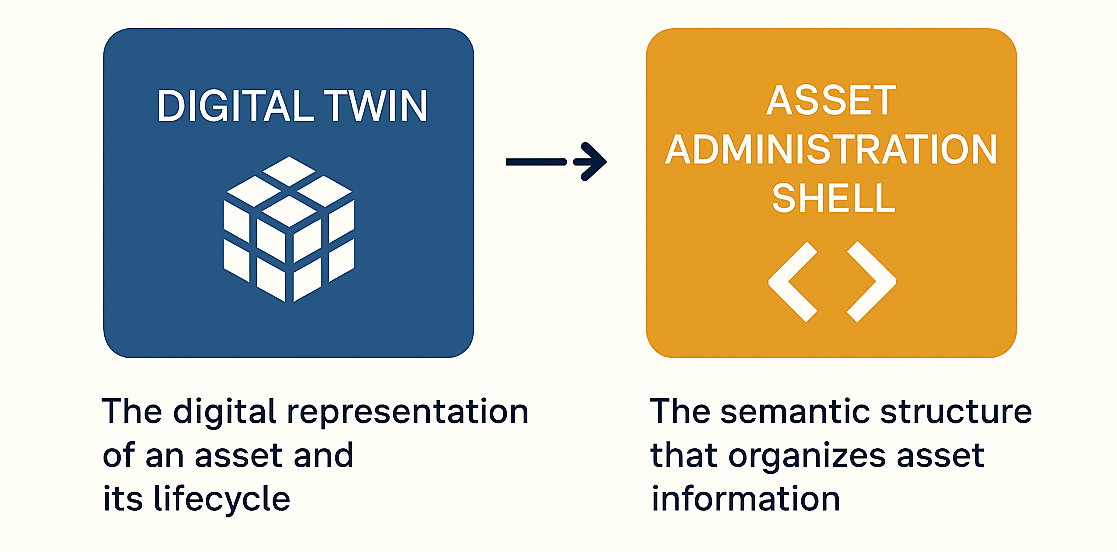
A Digital Twin is a comprehensive, structured digital representation of a physical asset across its entire lifecycle — from procurement and installation through operation, maintenance, and eventual decommissioning.
Unlike simple 3D models or isolated monitoring systems, a Digital Twin integrates all relevant aspects of an asset: its properties, current states, behaviors, relationships to other assets, and contextual information. In IDCM, this spans all three data center layers: a cooling unit in the Facility layer, a server rack in the Hardware layer, and a virtual workload in the Virtualization layer are all represented within the same unified model — connected through their real operational dependencies.
The Digital Twin is not a monolithic data store. It is a federated and semantic information object that unifies diverse data sources without requiring all information to be stored in one place. Its purpose is to provide clarity, interoperability, and consistency — enabling different systems, tools, and teams to work with a shared understanding of the assets they operate.
The Asset Administration Shell — The Semantic Backbone
The Asset Administration Shell (AAS) provides the structural and semantic foundation that makes the Digital Twin reliable and interoperable.
The AAS organizes asset information into standardized submodels — each grouping the properties, states, and services relevant to a specific use case. In a data center context, this means: a cooling unit's submodel contains temperature thresholds, power consumption data, and maintenance intervals; a server rack's submodel links to load metrics and hardware health states; a virtual workload's submodel references the physical resources it depends on. Each submodel is machine-readable, uniquely identified, and semantically consistent — regardless of which vendor or system originally produced the data.
Rather than replacing existing tools or databases, the AAS connects them. It maintains trustworthy references to authoritative data sources, ensuring that every value, state, or property shown in the Digital Twin is accurate, up-to-date, and contextually correct.
Our Project — DT and AAS Across the Three Data Center Layers
In IDCM, the Digital Twin and the AAS form a unified system built specifically around the three-pillar structure of the data center:
- The Digital Twin represents all three layers — Facility, Hardware, and Virtualization — as a single, lifecycle-wide model, making cross-layer dependencies visible and traceable.
- The AAS provides the structural and semantic backbone: standardized submodels, federated references, and consistent identifiers that ensure data from different teams, vendors, and systems can be integrated without ambiguity.
Together, they create an interoperable, future-proof foundation for monitoring, decision-making, and automation across the entire data center stack.
XR as the Human Interface to the Digital Twin
The Digital Twin and AAS provide the data foundation — but data alone does not solve the challenge of cross-layer understanding. Extended Reality (XR) is the interaction layer that makes this foundation accessible to operators and teams.
Through VR, AR, and MR environments, operators can explore the Digital Twin spatially: navigate between Facility, Hardware, and Virtualization layers, observe live asset states, and understand how conditions in one layer affect the others — without needing to access multiple disconnected tools. XR turns the structured data of the AAS into a coherent, human-navigable experience.
Summary
The Digital Twin provides a lifecycle-wide representation of all data center assets — across Facility, Hardware, and Virtualization. The AAS ensures that all information is structured, semantically correct, vendor-neutral, and connected to authoritative data sources. Together, they form the unified data foundation of IDCM — enabling consistent decision-making, cross-layer interoperability, and immersive interaction through XR. This turns a previously fragmented information landscape into a coherent, reliable, and future-ready operational foundation.