XR – Extended Reality in IDCM
What XR Is
Extended Reality (XR) is a collective term for three complementary immersive technologies:
- Virtual Reality (VR) — a fully digital environment that replaces the physical world, enabling operators to explore a complete virtual representation of the data center.
- Augmented Reality (AR) — digital information overlaid onto the physical environment, allowing technicians on the data center floor to see asset states, alerts, and dependencies directly on the equipment in front of them.
- Mixed Reality (MR) — a blend of physical and digital elements that supports shared workspaces, enabling distributed teams to collaborate in a common spatial environment regardless of their physical location.
Each mode addresses a different operational context. Together, they form a flexible interaction layer that makes complex infrastructure understandable across teams and situations.
Why XR Matters for Data Center Operations
Data centers consist of three interconnected layers — Facility, Hardware, and Virtualization — each with its own tools, specialists, and information structures. The dependencies between these layers are real and consequential: physical conditions affect hardware behavior; hardware states determine what virtualized workloads can run; a cascade from one layer to another is often only visible in hindsight.
Traditional interfaces — separate dashboards, alert systems, and documentation per layer — make it difficult to understand these relationships at a glance. XR changes this by representing all three layers within a single, unified spatial environment. Operators can explore the virtual data center, navigate between Facility, Hardware, and Virtualization, and see cross-layer dependencies as spatial relationships rather than entries in disconnected logs.
This makes patterns visible that would otherwise require significant time and expertise to surface — and it makes them accessible to team members who may not have deep familiarity with every layer.
XR for Collaboration and Knowledge Transfer
Beyond individual exploration, XR strengthens collaboration across disciplines. Facility managers, hardware engineers, and virtualization teams can meet in a shared virtual environment — examining the same asset, discussing the same dependency, from wherever they are physically located.
This is particularly valuable when dealing with restricted, remote, or sensitive infrastructure that cannot be easily accessed in person. XR enables operators to simulate scenarios, walk through planned changes, train new personnel, and conduct cross-team reviews — all without physical access to the data center. This reduces risk, accelerates onboarding, and removes communication barriers between disciplines that rarely share the same physical space.
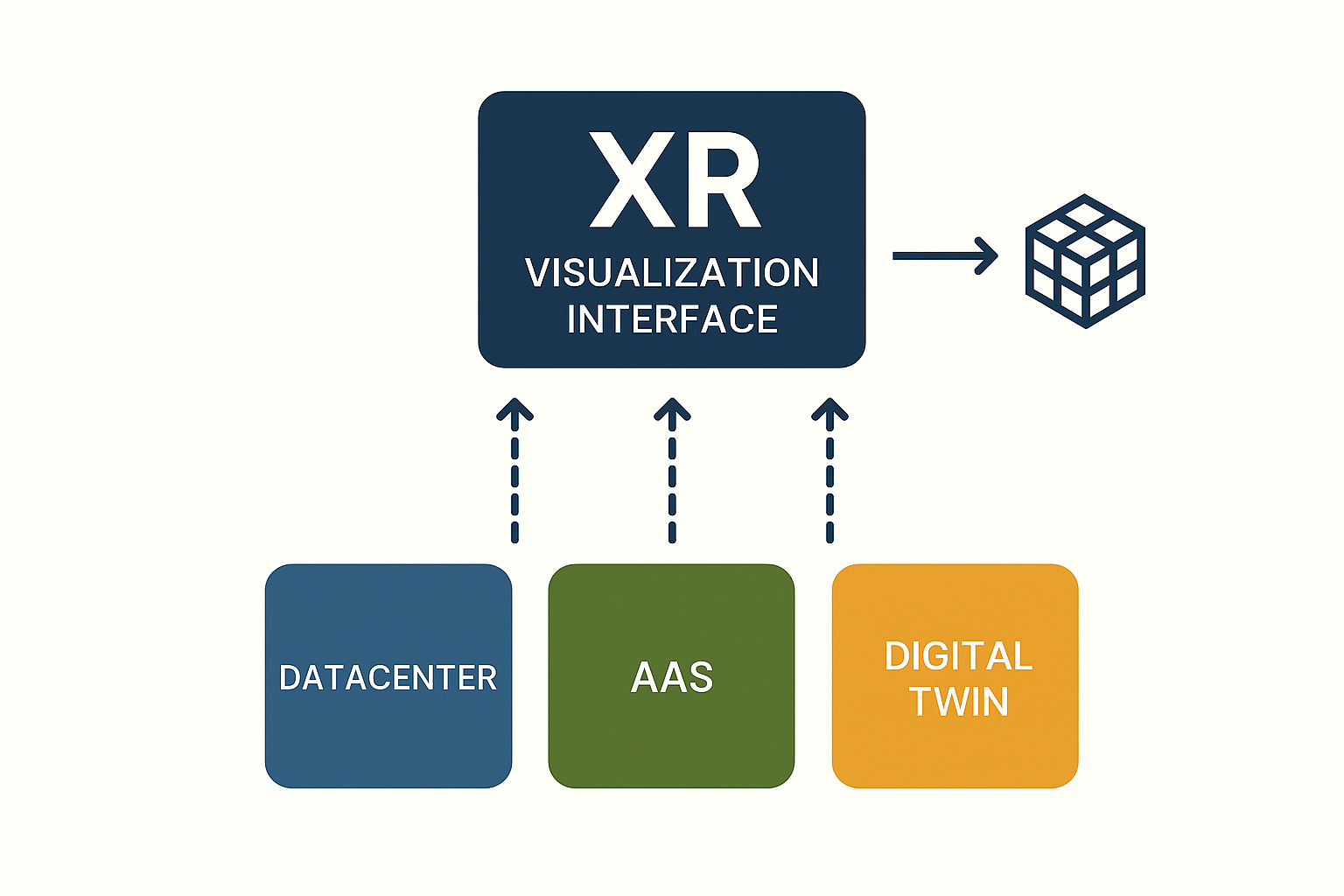
XR as the Interface Layer for Digital Twin and AAS
In IDCM's architecture, the Digital Twin and the Asset Administration Shell (AAS) provide the data foundation: a unified, semantic, and machine-interpretable representation of all data center assets across all three layers.
XR is the interface through which operators access that foundation. Instead of querying submodels directly or reading structured data outputs, operators navigate the Digital Twin spatially — using VR to explore the full data center environment, AR to inspect physical assets on-site, or MR to collaborate with remote colleagues in a shared view.
Because the underlying data is structured and semantically consistent through the AAS, every state, measurement, and relationship visible in the XR environment is accurate and traceable to its authoritative source. XR does not alter or interpret the data — it makes it human-navigable without sacrificing correctness.
Summary
XR makes the complexity of multi-layer data center environments understandable — spatially, intuitively, and collaboratively. In IDCM, it serves as the primary interaction layer for the Digital Twin and AAS: enabling operators to explore Facility, Hardware, and Virtualization as a connected whole, identify cross-layer issues visually, and collaborate across teams without requiring physical presence. It transforms structured data into a human experience — and makes the connected data center accessible to everyone who operates it.